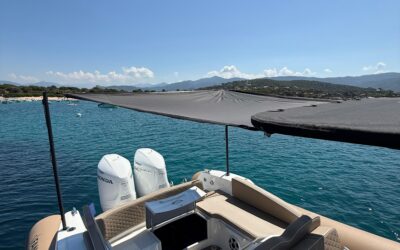
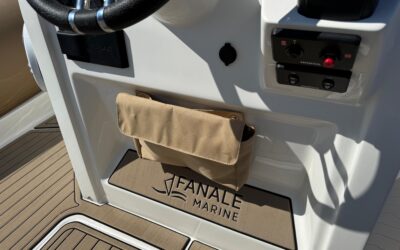
Whether it’s cruising, fishing, diving, water sports, or offshore sailing, a RIB is perfect for any activity. But you still need to choose the right model from an ever-expanding selection—ranging from 5-meter coastal boats to 14-meter vessels capable of long-distance crossings.
This guide offers a five-step method for selecting the RIB that best suits your intended use, budget, and technical requirements. Size, materials, motorization, and customization: each criterion is reviewed to help you develop a solid set of specifications before making a purchase.
Step 1 – Plan Your Itinerary
Before comparing models or engine horsepower, ask yourself the key question: What will you use your boat for? Your boating plans will determine every decision that follows, from the hull length to the choice of floats.
- For cruising and family outings, prioritize comfort: stability when docked, sunbathing areas, shade provided by a T-top or sun awning, and easy movement around the deck. The fuel tank should provide sufficient range for your usual cruising areas.
- For fishing and diving, focus on a clear deck with easily accessible storage (lockers, rod holders, hooks within reach). Stability at anchor is essential: choose a wide model with floats of a good diameter. For diving, make sure there is a sturdy reboarding ladder.
- For water sports, consider the weight-to-power ratio. A hull with a pronounced V-shape will ensure good course stability at high speeds. Make sure to include a spacious cockpit and the option to add an elevated tow point.
- For professional or rental use, the selection criteria expand to include: durability for regular and intensive use, ease of maintenance, compliance with capacity regulations, and high-quality materials (Hypalon rather than PVC) to maximize the lifespan of your float.
Would you like help designing your program? Our network of authorized dealers is here to provide you with personalized advice.

Step 2 — Choose the right size based on your needs
Length determines a boat’s performance at sea, passenger capacity, and onboard comfort. But it also affects transportation, storage, and the overall budget. To make the right choice, balance your sailing plans with the logistical realities of your daily life.
6 meters and up: the versatile entry-level model
You have a lightweight, maneuverable RIB that can be towed by a standard car. It’s the ideal size for regular coastal outings with 4 to 10 passengers and a moderate engine (80 to 140 HP). The Filanciu 650 , at 6.50 m long, weighing 800 kg, and with a 128-liter fuel tank with its 5.95-meter length, 750 kg weight, and 110-liter fuel tank, perfectly exemplifies this category: an excellent balance between compact size and spaciousness.
7 to 8 meters: the comfortable mid-range
You’re entering the segment favored by experienced boaters and professional rental companies. The deck accommodates 12 to 16 people, the range is increasing (200 to 300-liter fuel tank), and the available power (up to 350 HP) opens the door to water sports. Be mindful of the boat’s weight: This requires a suitable trailer and an appropriate towing vehicle.
Over 9 meters: the cruising RIB
Rigid-hulled boats are taking on a whole new dimension. Cabin, galley, berth: these vessels are designed for cruising.
Step 3 – Understanding the Materials: Hull and Floats
The choice of materials affects durability, performance at sea, and maintenance costs. Two components deserve your full attention.
The hull: polyester or aluminum?
Most recreational RIBs are built with a laminated polyester hull. This material offers a remarkable strength-to-weight ratio, is easy to repair, and allows for the creation of precise V-shaped hulls that cut through choppy water smoothly. Aluminum, which is lighter and more abrasion-resistant, is suitable for intensive professional use but is more expensive to purchase and repair.
Floats: PVC or Hypalon?
The floats are the heart of an inflatable boat. PVC, an economical thermoplastic, is suitable for occasional or moderate use but ages quickly under Mediterranean UV rays. Hypalon, the industry-standard synthetic elastomer, offers much better resistance to UV rays, hydrocarbons, and mechanical wear. Although more expensive to purchase, it pays for itself through significantly longer lifespan and easier maintenance. It’s the preferred choice whenever you plan to use the boat regularly or for professional purposes.
At Fanale Marine, all models starting with the Pichju 600 are equipped with Hypalon floats, a choice that emphasizes durability and is consistent with our artisanal manufacturing process.

Step 4 – Select the Right Motor
An undersized motor leads to excessive energy consumption and premature wear. An oversized motor adds to the cost without providing any real benefit. The right choice comes down to a simple calculation: the ideal power output falls between 70% and 100% of the maximum power authorized by the manufacturer, depending on your application.
The power-to-weight ratio
A 7-meter RIB rated for 250 HP will perform optimally with an engine between 175 and 250 HP. The lower end of the range is suitable for cruising and fishing; the upper end is ideal for water sports or high-speed cruising.
Gas or electric outboard motor?
The 4-stroke outboard motor remains the standard for RIBs. It is easy to maintain, simple to replace, and has moderate fuel consumption (around 0.45 to 0.55 liters per horsepower per hour at full throttle). Electric propulsion is gaining ground but remains limited to inland waters and protected areas: the range is not yet sufficient to support coastal or offshore voyages.
Fuel Tank and Range
Multiply the selected power by the tank capacity. A 6-meter boat with a 115 HP engine will require only 110 liters. A 9-meter boat equipped with a 350-horsepower engine will need 350 liters or more to cruise comfortably. At cruising speed (30% to 50% of maximum fuel consumption), this is what determines your actual daily range.
Step 5 – Personalization: A Criterion That Is Too Often Overlooked
Two RIBs of the same size and with the same engine can offer radically different boating experiences depending on their level of customization. This is a factor that traditional buying guides tend to overlook, yet it makes all the difference between a generic boat and one tailored to your plans.
Features That Transform the Onboard Experience
Float color, gelcoat shade, upholstery options, the addition of an aluminum T-top or stainless steel roll bar, teak table, galley, refrigerator, shower, non-slip flooring, and built-in sound system: these options let you customize every detail to suit your priorities. An angler won’t equip their RIB the same way a family cruiser would, and a professional charter operator will look for durable, low-maintenance finishes.
At Fanale Marine, customization is at the heart of our artisanal craftsmanship. Each boat is custom-built, from the choice of colors to the cockpit layout. It is this approach that transforms a catalog model into a boat designed specifically for its owner.
New or Used: How to Make the Right Choice?
The Benefits of New Construction
Buying a new boat offers three major advantages: the manufacturer’s warranty, access to full customization, and the benefit of the latest technical advancements. You’ll receive a boat configured exactly to your specifications, built with new materials and complete traceability.
How to Buy Used Items Wisely
A used boat is still a good option if you have a more modest budget or are looking for immediate availability. Focus your inspection on the condition of the floats (flexibility, watertightness, signs of repair), engine hours, maintenance history, and the overall condition of the hull (gelcoat, antifouling). A well-maintained used RIB, especially one equipped with Hypalon floats, has a remarkably long service life.
Check out our used RIBs available to see the boats currently offered through the Fanale Marine network.
Summary Table – Key Criteria for Choosing Your RIB
| Criterion | 5 to 6 meters | 7 to 8 meters | 9 meters and over |
| Max Capacity | 4 to 7 passengers | 12 to 16 passengers | 16 to 20 passengers |
| Approximate power | 40 to 140 | 175 to 350 HP | 350 to 1,100 HP |
| Tank | 100 to 150 L | 200 to 300 L | 350 to 1,000 L |
| Recommended Floats | Hypalon | Hypalon | Hypalon |
| Towing | Standard car | Accessible vehicle | Permanent Position |
| Example: Marine Beacon | Filanciu 650 600 | Falchettu 700 / Altagna 800 | Altore 900 / Libecciu 1000 |