Rigid-hulled or semi-rigid? The design of your boat determines its performance at sea, its onboard space, and its versatility. This comparison outlines the key criteria to help you make an informed decision based on your boating plans.
Rigid and semi-rigid hulls: two designs, two philosophies
A hard-hulled boat is built entirely from a rigid structure, typically made of laminated polyester, aluminum, or composite materials. The hull, keel, and sides form a single, monolithic unit. This category includes open boats, day cruisers, and cabin boats, whose dimensions and layouts vary considerably from one model to another.
A semi-rigid boat (or RIB, short for Rigid Inflatable Boat) combines a rigid hull with inflatable floats attached to the sides. This hybrid design gives it unique characteristics: the rigidity of the hull ensures good handling while underway, while the floats provide additional buoyancy, shock absorption, and excellent lateral stability for both open-water navigation and at anchor.
The table below summarizes the main differences between the two architectures:
| Criterion | Hard Case | Rigid-hulled inflatable boat (RIB) |
|---|---|---|
| Structure | Fully rigid shell and side panels | Rigid hull + inflatable floats |
| Weight (at equal length) | Heavier | Lighter |
| Stability at anchor | Moderate (some rolling possible) | Excellent (shock absorbers) |
| That's not true—it's actually the opposite, because SRs are certified to carry more people, since the regulations allow passengers to sit on the air cushions. | ||
| Clear deck area | Varies depending on the layout | Generally higher |
| Power-to-weight ratio | Less favorable | More favorable |
| Fuel Consumption | Higher | More controlled |
| Access to Water | High freeboard, less convenient access | Low freeboard, easy launching |
| Shock Absorption | Limited Edition (hardcover) | Natural (pneumatic floats) |
| Resistance to port maneuvers | Risk of scratches and chips | Floats absorb impacts |
| Specific Maintenance | Hull (antifouling, gelcoat) | Hull + floats (rinsing, cleaning) |
| Resale Value | Good | Good (Superior with Hypalon floats) |
These two construction philosophies are not in direct conflict with one another. They are based on different considerations regarding use, comfort, and performance, which should be analyzed criterion by criterion.
Performance at Sea: Stability, Wave Handling, and Maneuverability
Rigid-hulled inflatable boats: light weight, shock absorption, and stability at anchor
The main advantage of a RIB when sailing is its power-to-weight ratio. For the same length, it is significantly lighter than a rigid-hulled boat, allowing it to reach cruising speed more quickly and respond more nimbly to steering inputs. The inflatable tubes act as natural shock absorbers against choppy water and short waves, providing a smoother ride—a feature particularly appreciated on coastal routes.
When stationary, the RIB’s lateral stability is remarkable. The floats increase the buoyant surface area and reduce rolling, a key advantage for activities that require moving around on board (diving, fishing, boarding passengers).
On the other hand, its light weight makes it more susceptible to wind drift, which can make it difficult to maintain course in strong winds or to manage harbor maneuvers under certain conditions.
The rigid hull: weight, inertia, and comfort in rough seas
The hard hull uses its greater weight to provide better stability against the elements. In rough seas, on long, formed waves, it maintains a more stable course and absorbs the swell more evenly. This is a significant advantage for extended offshore voyages or exposed crossings.
Its generally higher freeboard provides better protection for passengers from spray and offers a greater sense of security when conditions deteriorate. On the other hand, this hull height makes access to the water (swimming, diving) less convenient than on a RIB.
Onboard Space, Amenities, and Passenger Capacity
It is often this criterion that most clearly distinguishes the two types of boats. A rigid hull offers more living space for the same length. The rigid sides allow for deep storage compartments, continuous bench seats, a sleeping cabin, and—on models longer than 7 meters—a galley or bathroom facilities. For boaters looking for living space on board (day cruises, occasional overnight stays), the rigid-hulled boat is the better choice.
Rigid-hulled inflatable boats, on the other hand, make up for this with an unobstructed deck area and greater versatility. The absence of wide, rigid sides frees up space for movement, a decisive advantage for scuba diving, fishing, or transporting equipment. Although the floats slightly reduce the usable width of the cockpit, they ensure safe movement on board thanks to their flexibility in the event of contact.
On custom-built, handcrafted RIBs, the interior layout can be partially tailored to the owner’s preferences: the position of the console, the seating configuration, and the choice of upholstery. This flexibility in layout is not always available on mass-produced rigid-hulled boats.
Performance, Engine, and Fuel Economy
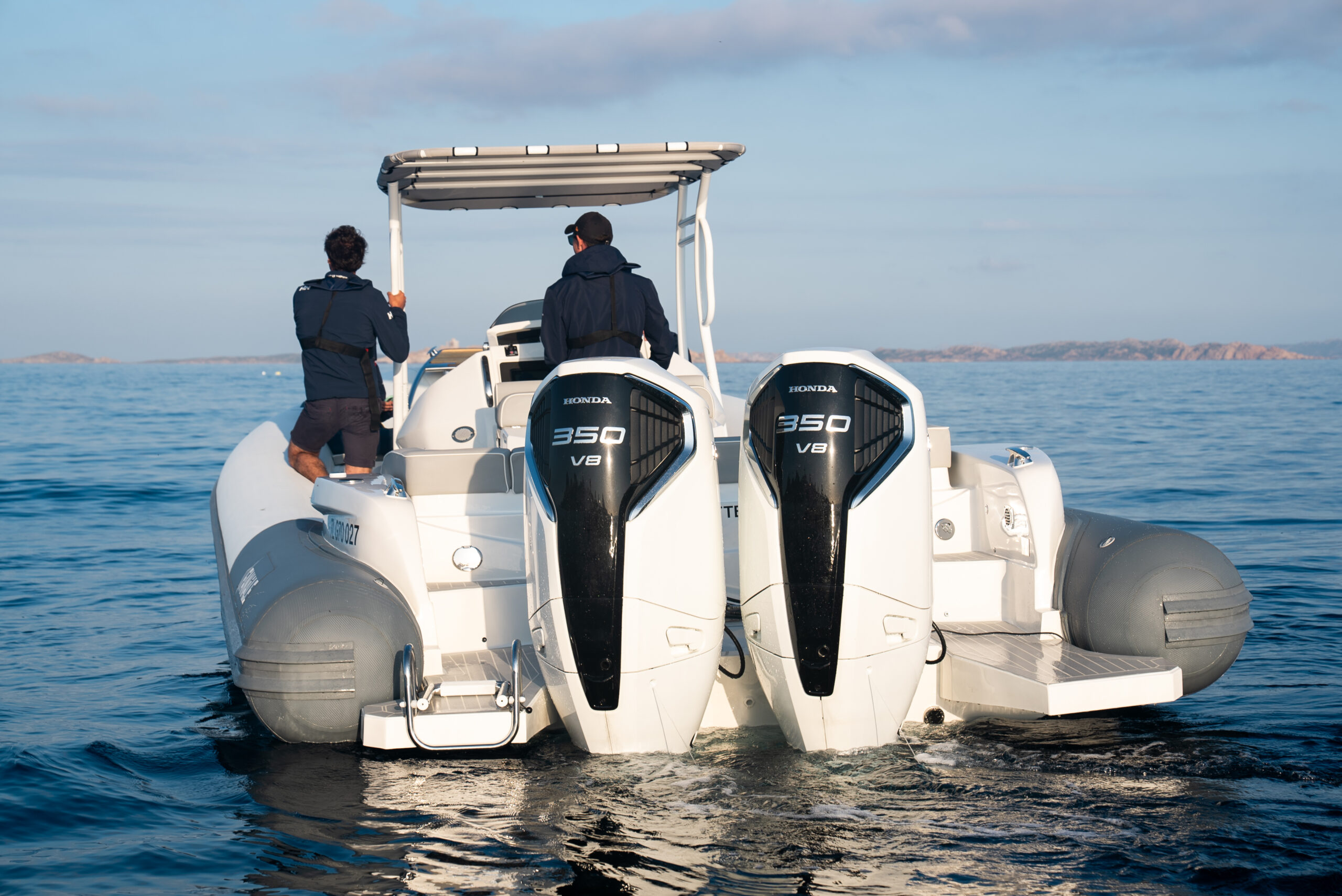
With equivalent engine power, the RIB offers superior performance in terms of acceleration and top speed, thanks to its lighter weight. A 7-meter RIB powered by a 250 CV engine will achieve speeds and responsiveness that a monohull of the same length could only match with significantly more power.
This difference in weight also affects fuel consumption. At comparable cruising speeds, the RIB consumes less fuel, which extends its actual range and reduces operating costs over a full season. For a rental company or dealer, this difference in fuel consumption represents a measurable selling point.
The rigid hull, which is heavier, requires more power to get up on plane and maintain a comfortable cruising speed. However, it compensates for this with superior comfort at a constant speed, with less vibration and engine noise that is often better dampened by the hull’s enclosed structure.
Maintenance, Durability, and Resale Value
Maintenance of a hard hull focuses primarily on the hull (antifouling, gelcoat, osmosis treatment) and mechanical systems. Structural materials (polyester, aluminum) do not require any special attention beyond standard winterization procedures.
On a RIB, hull maintenance is the same, but you also need to maintain the floats. Rinsing them with fresh water after each outing and performing a seasonal cleaning with a suitable product are enough to keep the floats in good condition. The durability of the float depends directly on the material: a Hypalon (CSM synthetic rubber) float can withstand UV rays, abrasion, and saltwater for 20 to 25 years, while a PVC float will age more quickly when exposed to intense Mediterranean sunlight.
On the used market, both types of boats retain a respectable resale value, provided they are regularly maintained. However, RIBs equipped with Hypalon floats are viewed more favorably by buyers, as the material’s durability instills confidence in the boat’s overall condition.
What Type of Boat for What Activity?
Scuba Diving and Spearfishing
Rigid-hulled inflatable boats clearly dominate this category. Three features set them apart:
- Its stability at anchor, which allows divers to gear up safely
- Its low freeboard, which makes it easier to tip the boat backward and push off with fins
- Its unobstructed deck space, which is essential for organizing the diving team's equipment
It is the top choice for clubs, training centers, and divers who own their own equipment.
Coastal and Offshore Fishing
Both types of boats are suitable for fishing, but each has its own distinct advantages:
- The RIB offers superior stability when stationary and allows for easy movement around the fishing station
- The hard shell offers more built-in storage (livewells, gear lockers, rod holders) and superior comfort during long trips on rough seas
For one-day inshore fishing trips, a semi-rigid boat is often the best compromise. For extended offshore fishing trips, a rigid-hulled boat has the edge.
Family Outings and Water Activities
Rigid-hulled inflatable boats, which are more agile and fun than hard-hulled boats, are better suited for activities such as water sports (wakeboarding, tubing) and swimming, thanks to their easy access to the water. They also appeal to boaters because of their spacious interior and comfortable amenities (sun deck, table, cabin).
Commercial Use and Rental
Most rental professionals prefer RIBs for several reasons:
- Versatility: A single boat can be used for diving, cruising, and water sports
- Impact resistance: The floats absorb impacts at the port and during customers’ docking maneuvers
- Controlled operating costs: reduced energy consumption and simplified maintenance
- Durability: Hypalon floats and the ease of repair through bonding reduce downtime for a fleet in rotation.
Handcrafted RIBs: When Customization Makes All the Difference
A comparison between rigid and semi-rigid hulls highlights a recurring observation: the limitations of semi-rigid hulls (living space, standard layouts) are directly linked to mass production. When a semi-rigid hull is custom-designed, these trade-offs are significantly reduced.
At Fanale Marine, each boat is handcrafted in Corsica, with fully customizable interior layouts, upholstery choices, float colors, and the placement of certain equipment. The laminated polyester hull and Hypalon floats, bonded together, ensure a structural integrity not found in standard RIBs.
If you'd like to discuss a project, please contact us.
Frequently Asked Questions
What are the benefits of a RIB?
The RIB combines the strength of a rigid hull with the buoyancy and shock absorption of inflatable tubes. The result is a lightweight, stable, versatile, and safe boat suitable for everything from family outings to diving, fishing, or professional use. Its favorable power-to-weight ratio delivers high performance with low fuel consumption.
What is the difference between a RIB and an open boat?
An open hull boat is a fully rigid vessel with no inflatable floats and an open cockpit (no enclosed cabin). A RIB shares this open configuration but is distinguished by the presence of inflatable floats on its sides, which provide lateral stability, shock absorption, and additional buoyancy. For the same length, the open hull generally offers more interior space, while the RIB has the edge in maneuverability and performance.
Can a rigid-hulled inflatable boat sink?
A RIB is designed to provide positive buoyancy thanks to its compartmentalized inflatable floats. Even if the hull takes on water, the floats keep the boat afloat. A properly maintained RIB, with floats in good condition and watertight compartments, offers a higher level of safety than a conventional hard-hulled boat in an emergency. This is, in fact, one of the reasons why marine rescue professionals and diving clubs prefer this type of boat.